It looks after itself.
A quiet health check runs on every device the home owns. A switch going silent raises its own service ticket before breakfast. Most faults heal before you ever feel them.
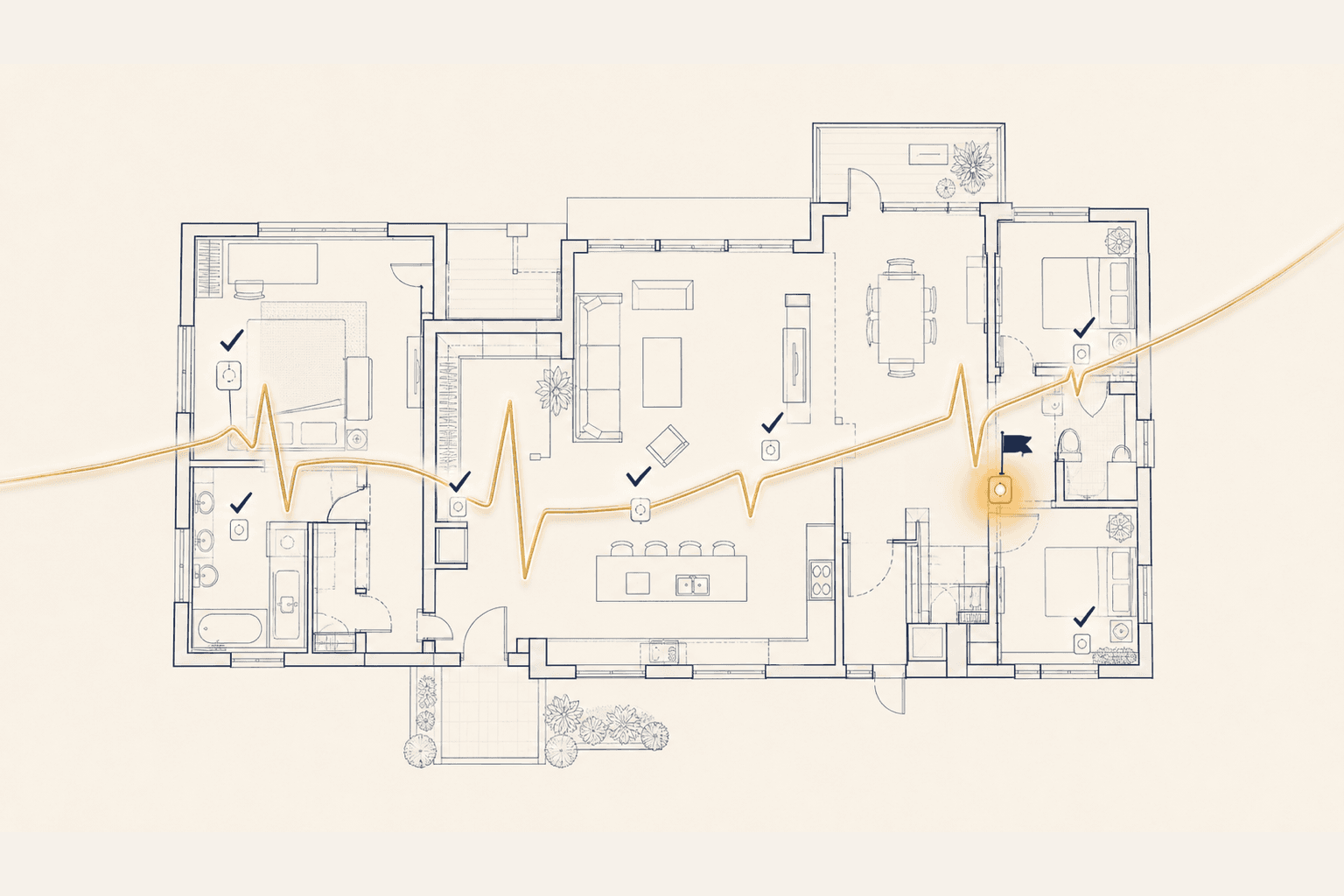
Unusual activity is flagged the moment it begins. Nothing about this asks for your attention until it genuinely needs it.
A smart home fails politely.
A sensor goes silent. A camera stops recording. A schedule quietly fails to load. Nothing beeps, nothing flashes. The system does not look broken; it looks like nothing at all, which is exactly the problem. So in most homes, faults are discovered by the family, at the moment of need, which is the worst possible time to learn about them.
Self-healing turns that around. The home checks its own pulse all day, repairs what software can repair, and files what needs hands. The discovery problem stops being yours.
A fault you discover yourself is a fault that was already old.
The health-check loop.
Four stages, running quietly on the hub inside the house, from the first heartbeat to the call you receive.
Heartbeats, around the clock
Every device the home owns answers a quiet roll call: switches, sensors, cameras, curtain motors, the gate, the network gear itself. One missed answer is noise. A pattern of missed answers is a fault, and the loop knows the difference.
Baselines, learned per device
The hub learns what normal looks like for each device: when it runs, for how long, how much current it draws. A geyser heating slower every week, a pump cycling too often. Drift shows up while it is still a whisper. This tier is rolling out across Living Homes.
Judgement before alarm
Not every blip deserves attention. A power flicker that knocked half the mesh offline for a minute is not twelve faults, it is one event. The loop separates weather from wear, and only what survives that filter goes any further.
The ticket, then our call
When something is genuinely wrong, the home writes the ticket itself: device, room, history attached, routed to the Onwords service team. Then the part that matters most: we call you to schedule. A self-raised ticket means you are informed, never tasked.
What self-healing includes.
Built and serviced by the team behind 7,000+ gate automations and 400+ smart homes across Coimbatore, Chennai, Bengaluru and Hyderabad since 2019.
Heartbeat monitoring
Every commissioned device answers the roll call, from switches to cameras to the gate. Silence is data.
Learned baselines
Run times, cycles and current draw learned per device, so drift shows up before failure does. Rolling out across Living Homes.
Soft-fault recovery
Mesh rejoins, service restarts, schedule reloads: the repairs software can make, made without you.
Self-raised tickets
Device, room and history filed straight to our service team, often before breakfast.
Network watch
The backbone is monitored like any other device, because every other device depends on it.
A team that calls you
Tickets land with the same crew behind our AMC plans at Rs 5,999 and Rs 8,999. We call you. You do not chase us.
Three layers of watching over.
From the reflex that never thinks, to the instinct that learns, to the memory that files the paperwork for you.
Instant safety rules
Some things can never wait to be learned. A water leak, a door forced at 3am, a load drawing far more current than it should. Hard rules fire the moment they are tripped, no thinking required.
Learned baselines
The home quietly learns what normal looks like for every device: when it runs, how long, how often. The moment behaviour drifts from that baseline, it is flagged, before it becomes a fault you would notice.
Offline-device auto tickets
A switch that goes silent does not wait for you to find it. The home raises its own service ticket, names the device and the room, and routes it to our team, often before breakfast.
The best service call is the one you never had to make.
The night a sensor went quiet.
02:12A verandah motion sensor misses its third roll call in a row. No alarm, no notification, no light stirs anywhere. The loop makes a note and keeps watching. The rest of the house sleeps on.
02:31The hub asks the sensor to rejoin the mesh, the quiet repair that ends most silences. Tonight there is no answer. The note changes status: not a blip, a fault.
06:58The home writes the ticket itself: verandah sensor, last seen 02:12, rejoin attempted, history attached. It is on our service desk before the kitchen light comes on.
09:20Our engineer calls you, not the other way around. The visit is booked around your day, not ours. The first you hear of the fault is the plan to fix it.
Health is one habit of one mind.
The same watchfulness that heals the home also learns it, and guards it.
Asked, answered.
01Will the house keep pinging me with alerts?
No. The health check is designed to be silent. Routine faults are handled and filed; you see a tidy history in the app, not a stream of notifications. The only interruptions are the ones you would actually want: safety events, and a call from our team when something needs a visit.
02What exactly happens when the home raises its own ticket?
The ticket lands with our service team carrying the device name, the room, and the history that led to the flag. An engineer reviews it, fixes remotely what can be fixed remotely, and calls you to schedule a visit for the rest. You are informed, not tasked. You do not chase us.
03Does self-healing replace the AMC?
It feeds it. Self-raised tickets route to the same service team that runs our AMC plans at Rs 5,999 and Rs 8,999, so cover and detection work as one system. The difference is who notices first: with the health check running, the ticket is usually filed before you knew there was a fault.
04Can the home actually fix things, or only report them?
Both. Many faults are soft: a device dropped off the mesh, a stalled service on the hub, a schedule that failed to load. Those the home repairs by itself, and you only ever see the log entry. Hardware failures cannot be healed by software, so those become tickets and, when needed, a visit.
05Does the health check work when the internet is down?
Yes. The loop runs on the hub inside the house, so heartbeats, baselines and safety responses continue without broadband. Tickets that need to reach our service desk queue on the hub and sync the moment the link returns. An internet outage is itself something the home notices and records.
06Which parts are live today?
Instant safety rules ship with every Onwords home now. The learned baselines and offline-device auto tickets are rolling out across Living Homes in stages. Homes we build today are hubbed and wired for the full loop, so the remaining tiers arrive as software updates, with nothing to retrofit.
A home that maintains itself.
It is one of four things the AIoT layer does. Next, it learns the way you live.