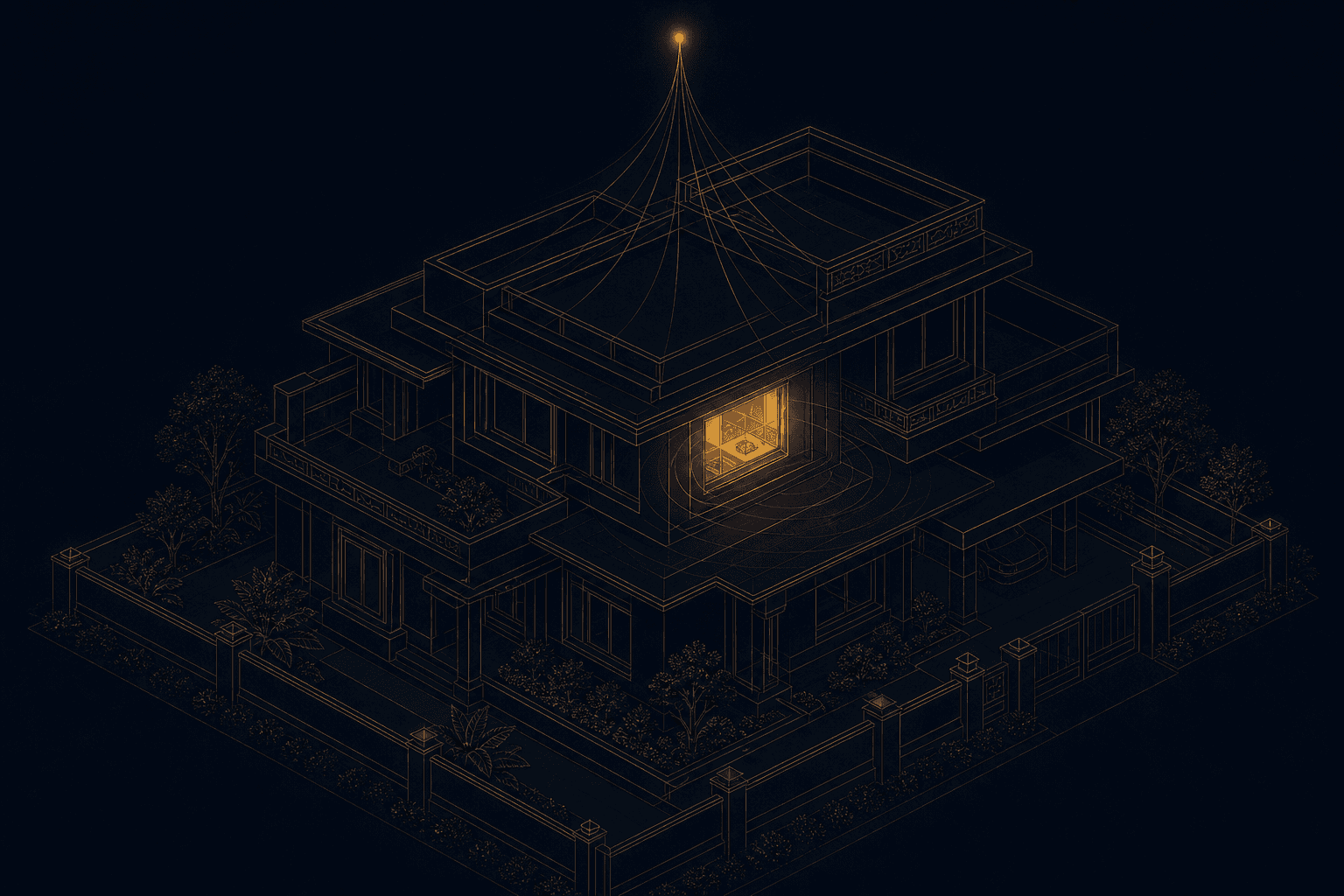
The home notices when something is off.
It learns your normal so well that one unusual evening stands out. Then it tells you, in plain words, once.
A smart home runs your commands. A living home knows your normal.
The most expensive moments in a home are the quiet ones.
Nothing beeps. Nothing fails. A light just stays on for six extra hours. A geyser runs through the afternoon. Each one is too small to notice and too frequent to ignore, and they add up on every bill and every morning after.
You cannot walk the house checking every hour. You were never supposed to. That is a job for something that never sleeps and never gets bored.
You cannot watch your house. Your house can.
Two ways to catch a broken day.
One watches the things you do. The other watches the state the house sits in. Between them, very little slips past.
The forgotten action
For about a week it learns your repeated actions: same device, same act, same hour. The off at 7:15, the dim at ten. When that moment passes today and nothing happened, and the device is still in its old state, it says so in plain words: “You usually turn off the kitchen light by 7:15 PM. It is still on.”
The broken portrait
Every 15 minutes it quietly photographs the whole house: what is on, what is off, what is set to what. Each slot of the day earns its usual portrait over the week. When right now does not match: “The hall is always dark by 10:30 PM. Tonight it is lit.” Nobody ever wrote that rule. The home learned it.
It speaks up. It never takes over.
When the home spots a break, it shows you exactly what it saw, the evidence behind it, and two buttons. Turn it off, and the fix happens from wherever you are. Dismiss it, and the home learns that tonight was an exception.
No silent switching, no surprises. Every alert and every outcome stays visible in the Onwords app.
What a week of normal looks like.
Every hour of every day earns its portrait. One cell glowing back is the whole story: tonight at seven, something is not how it usually is.
It knows the difference between odd and ordinary.
Season-proof
Habits that follow the sun are learned against sunrise and sunset, not a fixed clock. The gate lamp keeps its rhythm all year.
Knows an empty house
Alerts stay quiet when nobody is home. A missed 7 PM routine means nothing on a night the family is away.
Weekday and weekend
Saturday is allowed to be different. Each rhythm is learned separately, and only a break in today’s own rhythm gets flagged.
Whole scenes, one eye
Six exterior lights that always come on together are watched as one scene, so the one lazy bulb still gets caught.
Built to be believed.
An alert you stop trusting is worse than no alert. So the home is engineered to stay quiet, show its evidence and learn from every answer.
The grace window
An alert waits a few minutes past the usual moment. Life runs late sometimes, and the home allows for it.
Evidence, always
Every alert shows why it spoke: how many evenings it saw, at what time, with what confidence. No mystery boxes.
A cap on speaking
Alerts are capped, and most days there are none. Silence is a healthy output, not a missed one.
Dismissal teaches
A no is data. Dismiss an alert and the bar rises before anything similar is raised again.
Never acts alone
Nothing switches without your tap. Suggest first, always. Only the safety rules you chose act instantly.
Expires quietly
An alert you ignore retires itself instead of nagging forever. The home would rather watch than pester.
A month of watching, three taps.
A card, the first in four days. The kitchen light is usually off by 7:15; tonight it is still on. One tap from the sofa, and it is done.
The hall is always dark by 10:30. Tonight guests are over, so it is lit, and the alert is dismissed in a second. The home learns from that too.
The gate lamp follows the sun and is off by dawn. This morning it is still burning. One tap, and that is the third tap this month.
Nothing else. No noise, no drama. A home that only speaks when there is something worth saying.
Vigilance is one habit of one mind.
The same quiet attention takes other forms across the home.
Asked, answered.
01What counts as an anomaly?
Two kinds. A missed habit: something you do every day at the same hour simply did not happen today, like the kitchen light that is always off by 7:15 in the evening. And a broken portrait: the home knows what usually runs in every 15-minute slot of the day, so a hall light burning at 10:30 at night stands out even though nobody ever wrote a rule about it.
02Will it cry wolf?
It is built to stay quiet. A routine only becomes watchable after about a week of repetition. Every alert waits out a short grace window first, because life runs late sometimes. And a dismissed alert raises the bar before anything similar is raised again. Most days it says nothing at all, which is exactly the point.
03Does it act on its own?
No. Every alert is a suggestion with one tap either way: turn it off, or dismiss it. Nothing in your home changes without your say. The only things that act instantly are the hard safety rules you explicitly switched on, like a leak shutoff.
04What is it watching to know this?
Device states and the clock, never cameras or microphones. Every 15 minutes the home takes a quiet snapshot of which devices are in which state, and it learns your on-off rhythm from switch events. All of it is processed on the hub inside your home, and it stays there.
05Does it handle seasons, weekends and empty houses?
Yes. Habits that follow the sun, like a gate lamp at dusk, are learned relative to sunset so they hold all year. Weekday and weekend rhythms are learned separately. And the home knows when the house is empty, so it does not page you about a routine nobody was home to run.
06Is anomaly detection live today?
It is rolling out across Living Homes in stages, after proving itself in our own pilot homes. Homes we build now are wired and hubbed for it, so it arrives as software, with nothing to retrofit.

A home that speaks up.
Tell us about your home and we will show you what it feels like when nothing slips past it.
Book a walkthrough