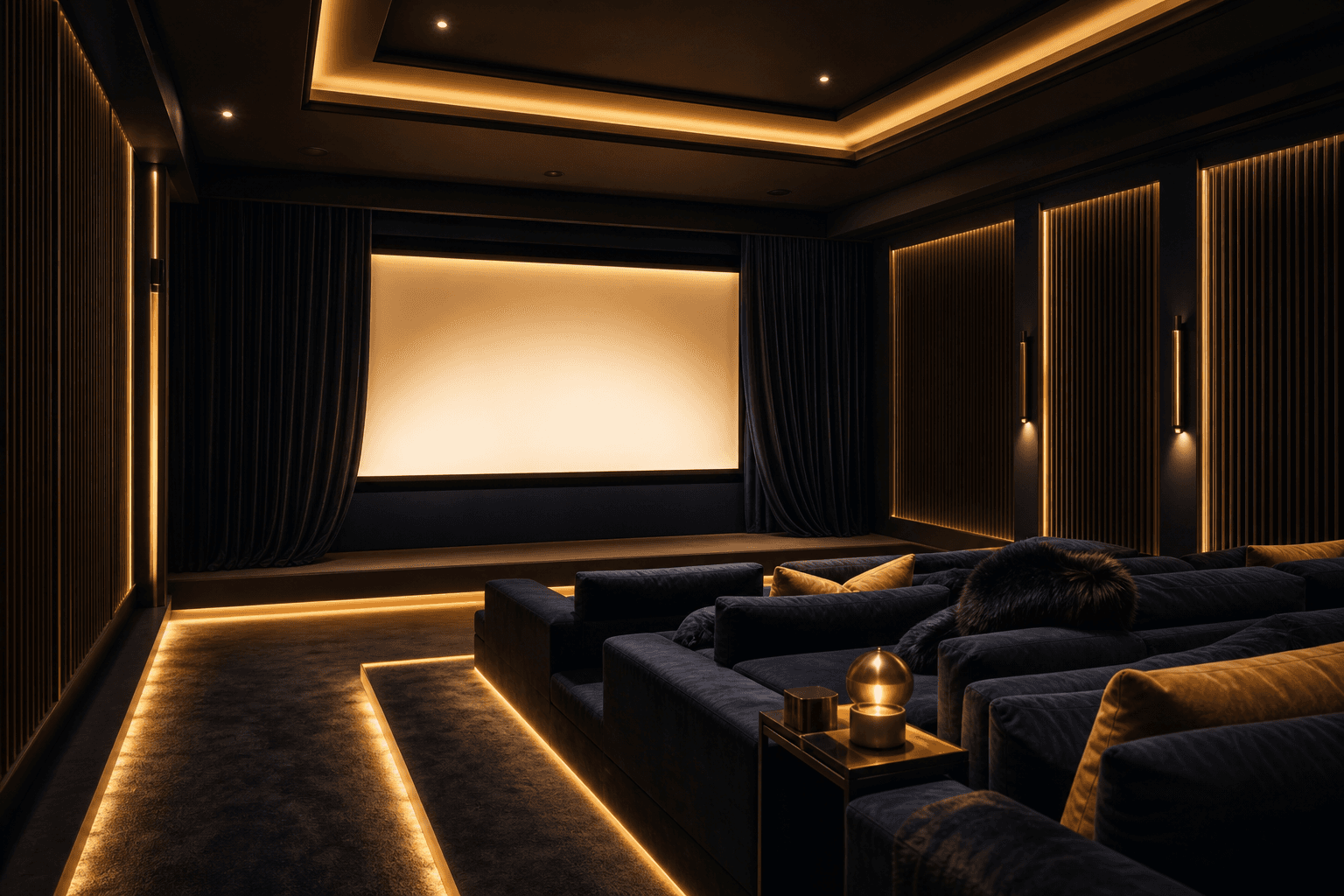
Movie night is one word.
Say it and the room obeys. The screen wakes, curtains draw, lights fall to a warm trail, sound comes alive.
Scroll, and watch the room wake.
Cinema, acoustics and automation, tuned as one build.
Not a television bolted to a wall and a soundbar hoping for the best. The picture, the sound and the room are designed against each other, by one team.
The room that never quite feels like cinema.
You know this room. The television is enormous and the soundbar was not cheap, yet every film sounds like it is being played in a bathroom. Dialogue bounces off tile and glass and arrives blurred, so the volume creeps up, and then the action scenes are deafening while the conversations still disappear.
None of that is the equipment failing. It is the room winning. Hard floors, bare walls and a screen sized by the showroom rather than the seating will beat any electronics you throw at them. Cinema is a room first and equipment second, which is exactly the order we build in.
The room decides how it sounds. So we design the room first.
Room, image, sound, home. In that order.
Every theatre we build follows the same sequence, whether it is a sealed cinema room or a living room that transforms.
Tame the room
Before a single speaker is chosen, we deal with the room itself. Panels and absorption where the echo lives, soft mass where glass and tile would smear the sound. The test is simple: quiet dialogue, clearly heard, at every seat. Everything else is built on top of that.
Size the image
4K projection is not a product, it is a set of measurements. Throw distance, screen width against seating distance, screen height against eye line, and how much light the room lets in. We size and align the image for the room you have, then calibrate it in the dark it will actually live in.
Calibrate the sound
Speakers go where the room says they should, not where the carton was unpacked. Then we measure from the seats: level, distance and delay for every channel, bass tamed to the room. The result is sound that arrives together, aimed at the people, not the walls.
Fold it into the home
The theatre joins the same hub, the same app and the same team as the rest of the house. That is what makes movie night one word: screen, curtains, lights and sound answer together. When we come in early, the wiring for all of it is planned before plastering, so nothing is taped on later.
4K projection
A screen that fills the wall and holds its detail in the dark. Calibrated, not just installed.
Calibrated surround
Speakers placed and measured to the room, so the sound arrives where it should, when it should.
Acoustic design
Panels, placement and materials that tame the echo, so dialogue stays clear and bass stays tight.
One-tap scene
Screen, curtains, lights and sound, all cued from a single word. The room becomes a cinema at once.
A finished room, not a pile of boxes.
Built by the team behind 400+ smart homes across Coimbatore, Chennai, Bengaluru and Hyderabad since 2019.
The room plan
Acoustic treatment, seating, screen and speaker positions on one drawing, agreed before any work starts. No surprises mid-build.
Concealed wiring
Speaker, signal and power runs routed in conduit, planned before plastering when we come in early. The room stays a room, not a cable tray.
The rack
Sources and amplification in one tidy, ventilated rack on protected power. Serviceable in minutes, invisible from the sofa.
A calibrated image
The projector aligned, focused and set for the room, then verified from the seats. You get the picture the film maker graded, not a showroom preset.
A measured soundfield
Every channel level-set and distance-set at the seating positions, with the measurements recorded so drift can be caught and corrected later.
The scene, authored
The movie-night scene programmed on the hub with you: what wakes, what draws, what dims, in what order. Refined after your first weekend with it.
“Movie night.”
The lights fall to a warm trail. The curtains close. The screen wakes and the sound settles in. You did not touch a single remote.
A Friday, properly spent.
20:47Someone says the word. The curtains draw themselves shut, the living room lights fall away to a warm trail along the floor, the screen wakes and the amplifier settles at the volume you ended on last week. Nobody stood up.
20:49The opening scene is mostly whispers, and every word lands. Behind the fabric on the side walls, the panels are doing their quiet work: no echo off the glass, no smear off the floor tiles. The subtitles stay off tonight.
21:58Interval. One tap on the armrest phone and the film pauses while the lights lift gently, just enough to find the kitchen. The path to the fridge glows softly; the rest of the house stays asleep.
23:21Credits. You say goodnight and the room hands itself back: curtains stay drawn, screen sleeps, amp powers down, the warm trail carries you to the bedroom and then goes out behind you. The cinema is a living room again.
The theatre is one room of a larger build.
The same hub, app and team run everything else. These builds make the cinema better.
Asked, answered.
01Do we need a dedicated room?
No. We build both: sealed dedicated theatres and living rooms that transform on cue. In a shared room the acoustic treatment is subtler and the screen shares the wall with daily life, but the same one-word scene still runs. The design changes with the room; the discipline does not.
02Why do you start with acoustics instead of equipment?
Because the room is the biggest component in the system. An untreated room smears dialogue and bloats bass no matter what electronics you buy. Panels, absorption and placement tame the echo first, so a sensible system in a treated room will beat an expensive one shouting into glass and tile.
03When should we bring you in during construction?
Before plastering. That is when speaker cable, projector power, screen recesses and conduit cost almost nothing to route and hide. We issue the wiring plan to your electrician and inspect before the walls close. Coming in early is the difference between a built-in cinema and visible trunking.
04Will the theatre work with the rest of the home?
Yes. It is tuned as one build with everything else: same hub, same app, same team. The movie scene talks to the same lights, curtains and climate the rest of the house uses. There is no second remote universe to learn and no separate vendor to call when something changes.
05Projector or a large TV?
It depends on the room, the light you can control and how far you sit. A dark, dedicated room rewards 4K projection on a properly sized screen. A bright family room often argues for a large panel instead. We measure the space and show you both cases before you spend anything.
06Who looks after it afterwards?
The same team that built it. The theatre can sit under Onwords AMC plans at Rs 5,999 and Rs 8,999 alongside the rest of the automation, so calibration drift, source changes and scene edits are one call. You never have to work out which of three vendors owns the problem.
Build the room that becomes a cinema.
A dedicated theatre, or a living room that transforms on cue. We design both, sound and light and automation as one.