KNX Home Automation in India (2026): Cost, Process and When It Is Worth It
KNX home automation is the wired, open ISO standard (ISO/IEC 14543-3) that premium Indian villas are built on. It runs on its own bus cable, works with the internet unplugged, and is designed to last 25 years or more. This 2026 guide covers what KNX actually is, when it beats wireless, what a KNX project really costs in India, how the installation runs end to end, which KNX brands are available here, and how Onwords builds it.
The short answer
- KNX is an open ISO/IEC 14543-3 standard on a dedicated 29V bus cable, not a brand and not a cloud service
- It keeps working with the internet unplugged, because each device stores its own program
- It is a new-construction decision, taken before plastering, not a retrofit product
- An Onwords KNX villa project typically starts around ₹4 lakh and scales with point count
- Cost is driven by controlled points, dimming and shading scope, never by square feet
- The ETS project file is the real deliverable, and you should be the one holding it
If your house is already finished and occupied, skip to retrofit smart home with no civil work instead. If you are still at the drawing stage, keep reading, then read the KNX wiring guide before your electrician starts conduiting.
What KNX home automation actually is
Most explanations of KNX in India start with the brochure and stop at "premium wired system". Six properties explain everything that follows, including the price.
An ISO standard, not a brand
KNX is standardised as ISO/IEC 14543-3 and EN 50090, maintained by the KNX Association. That matters commercially, not just technically: no single manufacturer owns it, certified devices from different makers talk on the same bus, and your house is not tied to one company staying in business. When somebody says they sell KNX, they are selling compliance with a public standard, not a private ecosystem.
A dedicated bus, separate from your power and your WiFi
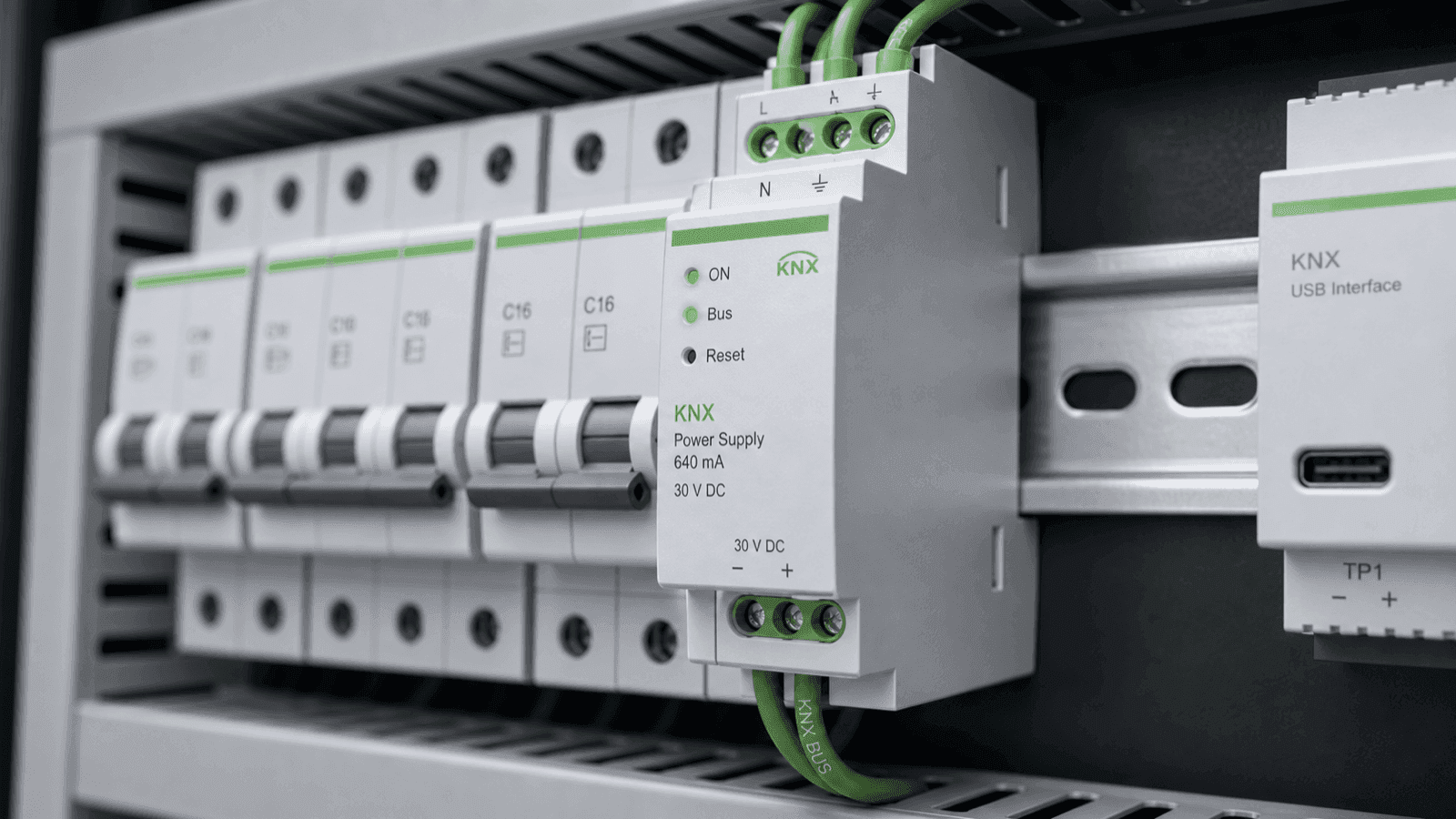
Every switch plate, sensor and panel is joined by a twisted pair bus cable carrying 29V, completely separate from the 230V load wiring and from your data network. The bus carries only intent, meaning the message that a button was pressed. The actual switching happens at actuators sitting in a distribution panel, which is why KNX handles heavy and awkward loads that a module hidden behind a switch plate cannot.
Decentralised intelligence, so there is no single brain to lose
Each KNX device stores its own programming. There is no central server that has to stay alive for the lights to work. If a touch panel dies, the rest of the house carries on. If a line coupler fails, the devices below it still operate locally. Compare this with a system where one hub failing turns every switch in the house into decoration.
It works with the internet unplugged
This is the sentence worth remembering. Scenes, schedules, sensor logic and every wall switch keep working with the router dead, because none of it depends on a cloud round trip. Internet is only needed for control from outside the house, voice assistants and notifications. Ask any integrator, us included, to pull the router in the demo and then operate a scene.
A 25 year plus service life, planned as building infrastructure
KNX installations from the 1990s are still running in Europe on their original bus cable. Because the intelligence sits on DIN rail in a panel and the cable in the wall is passive, you upgrade by swapping a module rather than by re-wiring a house. The correct mental category is electrical infrastructure with a long depreciation life, not a consumer gadget you replace every four years.
Engineered in ETS, not configured in an app
A KNX system is designed and commissioned in ETS, the KNX Association engineering tool. The integrator assigns a physical address to every device, builds a group address structure that maps buttons to loads, sets parameters, then downloads it to the bus. The output is a project file, and that file is the real deliverable of the job. Who holds it decides who can service your home in year eight.
If you want the hands-on version rather than the written one, we built a free interactive course with a live simulated bus line: the KNX Field Lab. The product page for the tier sits at KNX smart home.
When KNX is the right call, and when wireless wins
The deciding variable is almost never budget. It is the stage of construction, then the point count. A KNX system sold into the wrong situation is an expensive way to buy switches, and a wireless system sold into a 150-point villa is a support ticket waiting to happen.
| Your situation | The right call | Why |
|---|---|---|
| New villa, walls not yet plastered | KNX | The only window when bus cable and load home-runs are cheap. Conduit is the constraint, not budget. Decide with the electrical drawing, not after it. |
| Finished apartment, occupied family | Wireless retrofit | No civil work, install in days, physical switches keep working. KNX here means breaking walls for a benefit the family will not feel. |
| Large house, 100 plus controlled points | KNX | Point count is where wireless starts to strain and where a panel-based wired system gets simpler, not harder. Actuator channels scale in a DIN rail, not in the ceiling. |
| Heavy dimming, shading and HVAC scope | KNX | Dimming quality, curtain limit handling and multi-zone climate logic are where the wired standard shows the clearest daily difference over radio modules. |
| Small 2 or 3 BHK, wants app control and scenes | WiFi or Z-Wave | The value is convenience, and convenience is available at a tenth of the cost. Spending KNX money here buys engineering nobody in the house will notice. |
| Building now, automating in phases later | KNX cabling now, devices later | The cheapest possible insurance. Pull the bus cable and load home-runs during construction, close the walls, and add actuators room by room as budget allows. |
| Farmhouse or site with unreliable internet | KNX | Local operation is not a marketing line here, it is the requirement. A house that goes dumb when the link drops is not usable outside the city. |
| Commercial floor, hotel or multi-building campus | KNX | Segmentation, line couplers and an IP backbone were designed for exactly this. Repeatable room logic and central override are native, not bolted on. |
The row worth reading twice is the phased one. Bus cable and load home-runs pulled during construction cost a fraction of what they cost after plastering, and they commit you to nothing. Our wiring checklist before plastering exists for exactly this decision, and smart home for new construction covers the wider build timeline.
The real KNX home automation cost picture in India, 2026
The most common question is cost per square foot, and it has no useful answer. KNX is priced per controlled point, so two villas of identical area can differ by a factor of two. What we can give honestly is our own entry figure and the logic that moves it.
Where a KNX villa project with Onwords typically starts. This is Tier 3 of our four tiers, above WiFi retrofit and Z-Wave, below Crestron.
One point is one controlled circuit: a light group, a fan, a curtain, a valve, an AC. Count points, not rooms and not square feet.
Automation quotes are often shown ex-GST. Ask which number you are looking at before comparing two bids, the gap is material.
What actually moves the number
Number of controlled points
The single largest driver. A point is one circuit the system switches or dims: a light group, a fan, a curtain, a valve, an AC. Two houses of identical area can differ by 2x on point count alone, which is why per sq ft pricing is meaningless in KNX.
Switching versus dimming
A switching channel is cheap. A dimming channel, especially a universal dimmer that handles LED drivers cleanly, costs multiples of it. A lighting design heavy on dimmed scenes moves the number more than any other single choice.
Shading, curtains and blinds
Each motorised curtain needs a shutter actuator channel plus the motor itself. Curtain scope is usually underestimated at quote stage and then added mid-project, which is the most common reason a KNX budget slips.
HVAC and climate zones
Room thermostats, valve actuators and fan coil control add both devices and programming hours. A villa with per-room climate control is a different project from one with standalone split ACs and an IR bridge.
Panel space and distribution boards
KNX intelligence lives on DIN rail, so the distribution board grows. Undersized DBs are the classic Indian site mistake, and fixing one after the panel is fitted costs far more than specifying it correctly on day one.
Cable and conduit quantity
Bus cable plus load home-runs to the panel means more copper than conventional wiring. In a large or spread-out plot this is a real line item, and it is spent during civil work, before you see anything switch on.
Programming and commissioning hours
ETS work is engineering labour, and it scales with logic complexity rather than with hardware count. Ten scenes, presence logic, astronomical clock schedules and a Living Home OS layer on top are hours, and honest quotes show them.
Brand and device selection
Certified devices from different manufacturers interoperate, so a project can mix. Where the money goes is finish quality on the visible parts, glass panels and touch interfaces, more than on the actuators hidden in the panel.
Why two KNX quotes for the same house differ
When a buyer shows us a competing quote at half our number, the difference is almost always one of these five, and almost never a better price on the same scope.
One quote counts points, the other counts rooms
Ask both bidders for a point schedule, a line per controlled circuit. Without it you are comparing two different houses that happen to share an address.
Cabling is in somebody else’s scope
A cheaper quote often excludes bus cable, load home-runs, conduit and the labour to pull them, leaving it with your electrical contractor. That work does not disappear, it just moves off the page you are reading.
The panel is undersized on paper
DB size is where a quote gets quietly slimmed. Ask for the panel schedule and the module width count, then ask what happens when you add ten points in year two.
Programming hours are invisible
Hardware is easy to compare and labour is easy to hide. A quote with no commissioning line either buried it in the margin or is planning to do the minimum and leave.
GST is in one number and not in the other
Automation quotes are frequently shown ex-GST. Tax is added on top at the applicable rate, and on a ₹6 lakh scope that is over a lakh of difference between two numbers that looked comparable. Always ask which of the two you are looking at.
For where KNX sits against the cheaper and the dearer tiers on price, see our four smart home packages priced out and what smart home automation costs in India.
KNX vs WiFi automation, honestly
These are not competing products at the same point on the ladder. They are different answers to different building situations, and most Indian buyers should be choosing WiFi.
| Dimension | KNX (wired bus) | WiFi automation (wireless) |
|---|---|---|
| Where the intelligence sits | Distributed across devices on a dedicated bus, each storing its own program | In modules behind switch plates plus, usually, a cloud service |
| Behaviour with no internet | Full local operation, scenes and schedules unaffected | Varies by system, local control on some, dead switches on cloud-only ones |
| Civil work needed | Yes, bus cable and load home-runs before plastering | None, modules fit behind existing switch plates |
| Comfortable scale | Tens to thousands of points, whole buildings and campuses | Best under roughly a hundred devices on one network |
| Vendor freedom | Open standard, certified devices from many manufacturers interoperate | Depends on the platform, Matter has improved this considerably |
| Typical service life | Planned as building infrastructure, 25 years plus | Consumer hardware lifecycle, expect replacements sooner |
| Where it fits best | New construction, villas, commercial floors, phased builds | Retrofit apartments, rentals, first automation purchase |
For the full four-rung ladder including Z-Wave and Crestron, read WiFi vs Z-Wave vs KNX vs Crestron, and for the deeper wire versus radio argument, wired vs wireless home automation.
The KNX installation process, end to end
Eight stages, in the order they actually happen on an Indian site. Stage four is the one that cannot be redone, so it is the one to supervise.
Feasibility and design review
Before anything is priced, the floor plan, the electrical drawing and the construction stage are reviewed together. The output is a straight answer on whether KNX is the right call for this house at all. On plenty of sites, the honest answer is a wireless tier, and saying so early is cheaper for everyone than saying it in month four.
Point schedule and load schedule
Every controlled circuit is listed: which lights group together, which fans, which curtains, which valves, which are dimmed and which are switched. This document is the spine of the project. It sets the actuator channel count, the panel size, the cable quantity and the price, and it is what makes two competing quotes comparable.
Panel design and single line diagram
Actuators, power supplies, couplers and protection are laid out on DIN rail, with module widths counted and spare capacity reserved. Bus power supply sizing is checked against total device current draw. A panel planned with no spare width is a panel you will pay to replace the first time the family wants more.
Conduiting and cable pulling, before plaster
The irreversible stage. Conduit runs to every switch position and sensor location, KNX bus cable is pulled in a daisy chain, and load wiring home-runs back to the panel instead of looping switch to switch. Everything is photographed before plastering, because a wall closed over an unrecorded route is a fault you will hunt for years later.
Device installation and panel build
After civil finishing, actuators and power supplies are mounted and wired in the DB, switch plates and sensors are fitted, and the bus is terminated and continuity tested. Bus voltage is verified end to end before any programming starts, because chasing a software ghost that is actually a loose bus terminal wastes days.
ETS programming
In ETS, each device gets a physical address, group addresses are built to map every button to every load, and parameters are set for dimming curves, curtain travel times, scene numbers and logic. This is engineering work, and it is where a good integrator separates from a device fitter. The structure chosen here decides how easy the system is to extend in five years.
Commissioning, testing and correction
Every point is walked and tested: switch by switch, scene by scene, sensor by sensor. Labelling in the panel is checked against the schedule. Then the family lives with it for a period and a correction round follows, because the scenes people ask for on paper are never quite the scenes they want at 10 PM on a Tuesday.
Handover, documentation and the ETS file
The deliverables are the working house plus the paperwork: as-built drawings, the panel schedule, device addresses, warranty documents and a copy of the ETS project file. The file is the part most buyers forget to ask for and the part that decides whether another integrator can ever take over. Ask for it in writing before you pay the final instalment.
Each of these stages has its own deep guide. Cable specification, conduit sizing and panel requirements are in the KNX wiring guide. Site preparation and quality control standards are in the KNX site preparation and execution guide. Topology, bus segmentation, line couplers and power supply sizing for anything large are in large area KNX wiring best practices. And the stage-by-stage villa view is in the KNX villa project guide.
KNX brands available in India
KNX is an interoperability standard, so certified devices from different manufacturers work on the same bus. The list below is descriptive, not a ranking, and we do not publish other companies' prices. What separates them in practice is Indian availability, lead time, spares depth and the finish of the parts you can see.
Schneider Electric
A large multinational with a broad KNX range and a long-established Indian presence across electrical distribution. Widely specified where a familiar name and local distribution weigh heavily.
ABB
Another global electrical manufacturer with a full KNX portfolio, from actuators to room controllers, and an established industrial and building products channel in India.
Hager
European manufacturer known for distribution board and installation equipment, with KNX devices designed to sit naturally alongside its panel hardware.
Jung
German manufacturer with a strong reputation for switch and interface design, often chosen where the visible plate finish is part of the interior specification.
Gira
German manufacturer, likewise design-led on the visible interface side, with a broad KNX device range and well-known switch families.
GVS
KNX manufacturer whose devices are commonly encountered in Asian projects, frequently used where actuator channel cost per point is a live constraint.
Ekinex
Italian KNX manufacturer with a range covering actuators, sensors and interfaces, seen in projects that want European hardware with a distinct finish palette.
A practical note that saves projects: the actuators live in a panel and nobody ever looks at them, while the switch plates and touch interfaces are on the wall in every room. Spend the brand budget where it is visible, and select the hidden hardware on availability and channel cost. Mixing manufacturers on one bus is normal engineering practice, not a compromise.
How Onwords does KNX
We are a Coimbatore-headquartered automation company serving Tamil Nadu, Karnataka and Telangana, with over 7,000 automatic gates installed and seven years in the field. KNX is one of four tiers we build, which changes the incentive when we sit across from you.
KNX is our third tier, not our only answer
We build four tiers: WiFi retrofit from around ₹50,000, Z-Wave with touch panels, KNX villas from roughly ₹4 lakh, and Crestron estates at the top as an authorized dealer. Because all four are quoted by the same team, nobody here has a reason to push you onto KNX when your house does not need it. That is the practical value of carrying the whole ladder.
Living Home OS rides on top of the bus
KNX is superb at deterministic control and indifferent to user experience. Our own software layer, Living Home OS, adds the app, the scene design, usage history and Iniyal, our home AI, on top of the KNX layer. The bus keeps doing its job locally whatever happens to the software, which is the correct division of labour.
Apple Home and Matter bridged, not bolted on
A KNX house we build is bridged to Apple Home and Matter, so Siri, the Home app and Matter-certified devices sit alongside the wired system rather than in a parallel universe. The bridge is a convenience layer by design, and pulling it out leaves the house fully operational.
Our own install and service team, not a subcontract chain
Design, cabling supervision, panel build, ETS programming and post-handover service sit with one accountable team across Tamil Nadu, Karnataka and Telangana, out of our Coimbatore headquarters. Automation fails at the service layer, not at the sale, so ask any integrator where the nearest engineer physically sits.
You keep the ETS project file
The project file, the as-built drawings and the panel schedule go to the homeowner at handover. It is your building. Holding the file hostage is a business model, not an engineering practice, and it is the first thing to ask any KNX bidder about.
An experience centre you can walk into
Our Coimbatore experience centre exists so this page is not the evidence. Come and press the switches, ask us to unplug the router, watch a KNX scene run anyway, then go do exactly the same at every other company you are considering.
The four tiers, so you can place yourself
- Tier 1, WiFi retrofit from around ₹50,000, no civil work, finished homes
- Tier 2, Z-Wave mesh with touch panels, Living Home OS from here upward
- Tier 3, KNX villas from roughly ₹4 lakh, new construction, wired bus
- Tier 4, Crestron estates, as an authorized Crestron dealer
If you are still shortlisting companies rather than technologies, we wrote an honest comparison of the best smart home companies in Tamil Nadu that includes our competitors and how to check every claim on this page. For the software layer that sits on top of a KNX bus, see Living Home OS.
Eight questions to ask any KNX integrator, including us
Most buyers spend the site visit asking about price. These eight tell you far more about what you will be living with in year five.
Can I see the point schedule before I see the price?
A KNX quote without a line per controlled circuit is a guess wearing a total. The schedule is what makes two bids comparable and what stops the scope quietly shrinking after the advance.
Is the bus cable, conduit and home-run wiring inside this quote?
The most common reason one quote looks cheaper. That copper and that labour exist either way, so find out whose scope they sit in before comparing totals.
What is the panel size and how much spare width is left?
Ask for module widths and the reserve. A DB with no spare capacity means the first expansion costs a new panel rather than a new actuator.
Do I get the ETS project file, in writing?
Put it in the purchase order as a handover deliverable alongside as-built drawings. This is the single clause that keeps your options open for the next twenty years.
Show me the house with the router unplugged.
Not a verbal answer, a demonstration. Operate a scene, a schedule and a motion sensor with no internet. Whatever still runs is what you actually bought.
Who does the ETS programming, in-house or subcontracted?
If the programming is subcontracted, ask who returns for a change request in year three and whether they will still have your file.
What is the written service response time after handover?
Hours or days, in writing, and what it covers. Every real failure happens long after the installation team has left the site.
What will twenty more points cost me in two years?
Almost every family expands. Ask whether the existing panel, bus and programming structure carry the expansion or whether growing means re-doing the core.
KNX home automation FAQ
Square feet is the wrong unit. KNX is priced per controlled point, meaning each light circuit, fan, curtain, valve or AC that the system switches or dims. A 4,000 sq ft villa with 60 points costs far less than a 3,000 sq ft villa with 140 points and full dimming. As a working reference, a KNX project with Onwords typically starts around ₹4 lakh for a villa and rises with point count, dimming, shading and HVAC scope.
Read next
KNX Wiring Guide
Exact conduit, cable and panel requirements, to be read before plastering.
KNX Villa Project Guide
Is KNX worth it for your villa, and how a villa project runs stage by stage.
KNX Site Preparation and Execution
The execution standard: DB design, cable standards, supervision, quality control.
Large Area KNX Wiring Best Practices
Topology, segmentation, couplers and power supply sizing for big projects.
WiFi vs Z-Wave vs KNX vs Crestron
The full technology ladder on cost, reliability, lifespan and fit.
KNX Field Lab, free course
Interactive lessons with a live simulated KNX bus line you can operate.
Best Smart Home Companies in Tamil Nadu
An honest comparison including our competitors, and how to check every claim.
Crestron Home Automation in India
The tier above KNX, what it costs here, and when KNX is the smarter buy.
Get a KNX Quote
Send your floor plan and construction stage, get a point schedule and a line-item BOQ.