Crestron Home Automation in India: What It Is, What It Costs, Who It Is For
Crestron is the system running boardrooms, super-yachts and the world's most expensive homes. Onwords is an authorized Crestron dealer, and this is the honest picture: what it does that nothing else does, what a real Indian project costs, and when KNX is the smarter buy.
What Crestron actually is
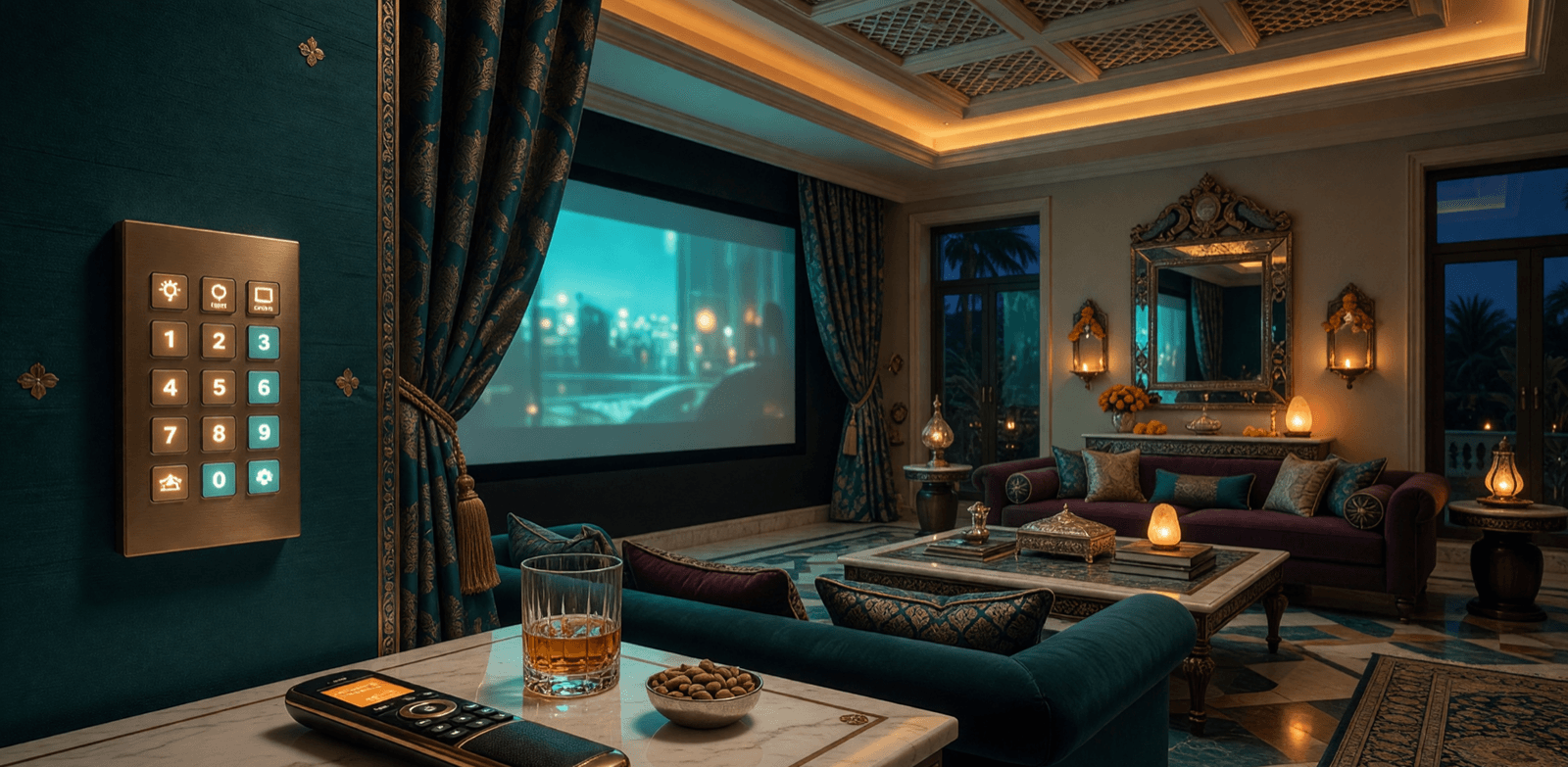
Crestron is not a product you buy off a shelf. It is one complete ecosystem, made by a single American company, where every part is built to work with every other part. A central processor runs the house. Touchscreens, keypads and handheld remotes are the way you talk to it. Lighting modules, shade motors, climate controllers and audio and video distribution are the things it controls. All of it is engineered as one system and then programmed by a dealer for your specific home.
That single-vendor design is the whole point. Because Crestron makes the processor, the panel, the keypad and the AV chain, nothing is left to chance at the joins. It is also why Crestron is a closed, dealer-only world: you cannot buy it and set it up yourself, and the quality of the install depends heavily on who programs it.
The brain and the wiring
- Control processor that runs the whole estate
- Lighting dimming and switching panels
- Shade motors, climate and pool or garden zones
- Rack, network and power management
The way you touch it
- Wall and tabletop touchscreens
- Engraved keypads that read like the room
- Handheld remotes for cinema and media rooms
- Phone, tablet and voice on top
What it does that nothing else does
Plenty of systems switch lights. Very few make a 10,000 sq ft house feel like one object. Three things are genuinely hard to get anywhere else.
One remote for everything, and it never argues
Lights, shades, air conditioning, music, projector, screen, gate and cameras all answer to the same interface. Not four apps that each do a bit. One press to watch a film, one press to leave the house, and the room follows without a pause.
Cinema-grade AV distribution
This is where Crestron has no real rival at home scale. Video from a central rack to every screen in the house over one cabling scheme, audio in every zone at the right level, and a dedicated theatre that is calibrated rather than assembled. See our home theatre automation guide for what that room looks like on its own.
Bespoke interfaces, not stock menus
The touch panel is drawn for your house: your room names, your floor plan, your scenes, in your interior palette. Guests understand it without a tour, and the keypad engraving means nobody has to remember which button is which.
Crestron Home vs custom programming, in plain words
There are two ways to build a Crestron house, and the choice changes both your bill and your timeline.
Crestron Home
Think of it as a ready-made framework. The dealer adds your rooms and devices, and the interface builds itself in a standard, well-tested layout. Faster to commission, cheaper on engineering, easy to hand over, and easy for another dealer to service later. The trade is that you live inside its way of doing things.
- Best for most villas, even large ones
- Weeks of programming, not months
- Lower engineering cost in the quote
Custom programming
Here the dealer writes the system from scratch, so anything you can describe can be built, down to a single button that runs a 40-step sequence. It is how the very large estates and unusual requirements get done. The trade is cost, time, and the fact that you are tied to whoever wrote it.
- Best for estates, yachts and odd requirements
- Anything is possible, nothing is quick
- Highest engineering line in the budget
Our honest default is Crestron Home for the great majority of Indian residential projects, with custom work reserved for the parts that genuinely need it.
The real cost anatomy of a ₹25 lakh to ₹60 lakh project
Nobody buys a lump sum, they buy line items. Here is roughly where the money goes on a full Crestron villa or estate in India. The percentages move with your priorities, a cinema-heavy house tilts to AV, a glass-heavy house tilts to shading.
| Line item | Share of budget | What it covers |
|---|---|---|
| Processors and control backbone | About 10 to 15 percent | The processor that runs the house, network switches, racks, power management and the wiring that ties every subsystem together. |
| Lighting control and keypads | About 20 to 30 percent | Dimming and switching modules in the panel, engraved keypads in every room, and the scene design that makes them worth pressing. |
| Touch panels and remotes | About 10 to 15 percent | Wall touchscreens, tabletop panels and handheld remotes such as Cevo, plus the custom interface layout drawn for your family. |
| Motorized shading | About 10 to 20 percent | Motors, tracks, fabric and the pockets your carpenter builds for them. Shading is usually the most underestimated line in a luxury quote. |
| Distributed AV and cinema | About 20 to 35 percent | Multi-room audio, video distribution to every screen, and the dedicated theatre room if you are building one. This line moves the total the most. |
| Programming, commissioning and tuning | About 10 to 15 percent | Dealer engineering time: writing the system, loading it, testing every keypad, and coming back after you move in to tune it around how you actually live. |
Two things surprise most buyers. First, hardware is not the whole story: programming and commissioning are a real line, and cutting them is how a beautiful system ends up feeling clumsy. Second, a single cinema room can be done for less as part of a wider system, so you do not have to start at ₹25 lakh to have any Crestron in the house.
Where this sits against everything else we install is laid out in our smart home packages guide and the WiFi vs Z-Wave vs KNX vs Crestron comparison.
Crestron and KNX together
On the largest projects these are not rivals, they are layers. KNX is the open wired backbone: every light, sensor, valve and AC zone sits on a bus cable that is vendor neutral and built to outlive the house electronics. Crestron sits above it as the experience layer, owning the interfaces, the AV and the one-touch scenes.
KNX does the backbone
- Lighting circuits, dimming, AC zones, valves
- Open standard, many vendors, long life
- Keeps running with no dependence on the cloud
Crestron does the experience
- Touch panels, keypads, remotes, scenes
- Distributed audio and video, cinema rooms
- Shading choreography across the whole house
Estates above ₹40 lakh often run both. We are a KNX partner as well as an authorized Crestron dealer, so we design the two together instead of forcing one to do the other one's job. The wiring plan for the KNX side is in our KNX villa project guide.
Crestron plus Living Home OS: a home AI on a Crestron estate
Crestron gives you flawless control. Living Home OS, our own software layer, gives the house a brain on top of it. That is the part most Crestron estates in India are missing, and it is the reason we bothered to build our own OS instead of reselling someone else's.
- Iniyal, our home AI, answers in plain language and knows the house, so you can ask for a mood instead of hunting for a scene
- True automation that acts on its own: presence, time, sunlight and sensors, not just buttons waiting to be pressed
- One family app across every layer of the estate, including the gate, cameras and anything that is not Crestron
- Local first, so scenes, schedules and sensors keep working when the internet is down
Crestron stays the control and AV layer it is unbeaten at. Living Home OS rides on top and turns it from a very good remote into a home that thinks.
Who should not buy Crestron
We sell Crestron, and we will still talk you out of it when it is the wrong buy. Skip it if any of this sounds like you.
Your budget is under ₹25 lakh
A stretched Crestron project is worse than a well-built KNX one. Below this band, our KNX tier (₹4 lakh to ₹30 lakh) and Z-Wave tier (₹2 lakh to ₹6 lakh) deliver around 90 percent of the outcome at a fraction of the price.
You have no serious AV requirement
If there is no cinema room, no multi-room video and no whole-house audio, you are paying for the strongest part of Crestron and not using it. Lighting, climate and shading alone are KNX territory.
The home is already finished
Crestron wants cabling planned before plastering. On a completed house, a wireless retrofit gets you a real smart home in days without tearing up walls.
You want to tinker with it yourself
Crestron is dealer-programmed by design. If you enjoy changing things yourself at two in the morning, an open platform under Living Home OS will make you happier.
Frequently asked questions
Real residential projects run ₹25 lakh to ₹60 lakh for a villa or estate, covering processors, touch panels, keypads, lighting, shading, climate and distributed AV, plus programming. A single cinema room can be done for less as part of a wider system.
Keep reading
Smart Home Packages in Tamil Nadu
All four budget tiers, from ₹50K WiFi retrofit to ₹60L Crestron.
WiFi vs Z-Wave vs KNX vs Crestron
The honest technology ladder, and which rung fits your home.
KNX Villa Project Guide
The wired backbone: planning, cabling and what a villa really costs.
Home Theatre Automation
One touch that dims the lights, closes the curtains and starts the film.